That white thing in the sage might be a shed. It might also be a beaver stick, a cow bone, or an antler so old it's turning to chalk. Here's how to tell, plus the rules if what you found is still attached to a skull.
Quick check
| What you've got | What you'll see |
|---|---|
| Fresh shed | Burr ring, then a rough, rounded base with nothing attached. Still has its color. Solid and heavy for its size. |
| Old chalk | Same shape, but sun-bleached white, light, cracked or flaking. |
| Chewed | Tips or edges gnawed off, with fine paired grooves from rodent teeth. |
| Beaver-cut wood | Angled point with flat tooth grooves, bark, and growth rings on the cut end. Found near water. |
| Dead head | Antler still on a bony pedicle and part of the skull. Read the rules before you pick it up. |
Wood or bone?
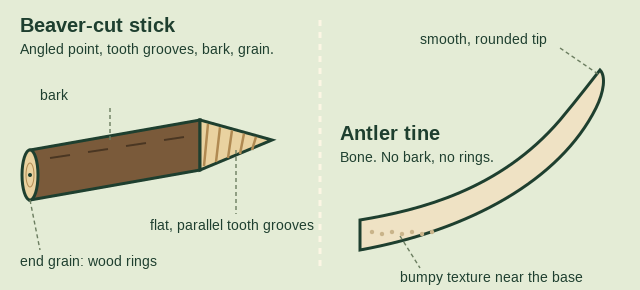
Along creeks and river bottoms, beaver-cut willow and cottonwood fool a lot of people at a distance. The NWF beaver sign guide describes the ends as angled cuts grooved by beaver teeth. Across the grain you can see parallel tooth grooves, and an adult beaver's upper incisor is about 6.5 mm wide, the widest of any rodent. A fresh cut is bright or moist inside. An old one is dry and drab, cracking or fraying at the ends.
An antler tine has none of that: no bark, no growth rings, no flat chisel cuts. It tapers to a smooth, rounded tip and feels like bone, because it is.
Source: National Wildlife Federation, Beaver Tracks and Sign; Montana State University Extension, antlers are true bone.
Shed or dead head? Look at the base
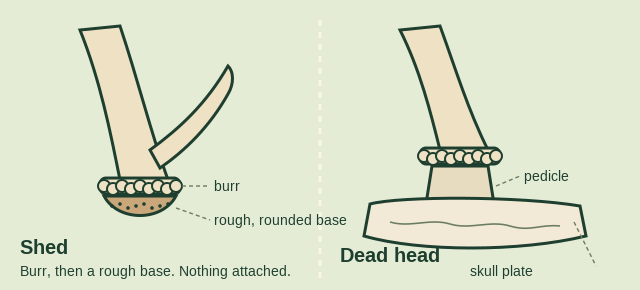
Antlers grow from permanent bony bases on the skull called pedicles. Well after the rut, bone along the line where pedicle meets antler gets broken down until the antler drops. The Mississippi State Deer Lab notes that the surface left on the base of a cast antler is rough in texture, and it can be flush with the burr or stick out past it. Montana State University Extension calls that disk the seal: convex on a buck that's still getting bigger, flat once he's peaked, concave as he declines.
- Shed: burr ring (the bumpy collar), then the rough seal, and nothing else.
- Dead head: the antler runs smoothly into a column of bone below the burr, the pedicle, and that sits on skull.
- The odd one: the Deer Lab notes that after an injury or infection, the break can run deep into the pedicle, so a shed can come off with a jagged chunk of pedicle on it. A cut skull plate is a different thing. That's a hunter's work.
Source: Mississippi State University Deer Ecology and Management Lab, Antler growth cycle; Montana State University Extension, Developing trophy antlers.
Fresh or chalk?
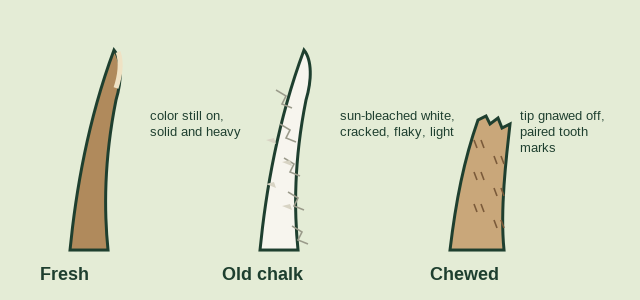
Antlers that people and rodents don't find get bleached, softened and weathered away by sun and rain (Texas Parks and Wildlife). In leaf litter back east, NYSDEC says some last for years and turn porous and stained dark brown. Out here in the sage it mostly goes the other way: a shed that's sat through a summer or two goes white and chalky, and eventually cracks and flakes. We call those chalk.
A fresh one still has its color and heft. Chalk is fine for the shelf. It's not much for a carving or a dog chew, and it doesn't tell you much about where the animals are this year.
White specks fool everyone. NYSDEC's tip is to look for white curved shapes, and to use binoculars to save a lot of walking to "faux antlers": bleached branches, bones and rocks.
Source: Texas Parks and Wildlife, White-tailed deer; NYSDEC Conservationist, shed antler search (2005).
Chewed antlers
Antler is a stash of calcium and phosphorus. USFWS says mice, squirrels and porcupines gnaw on sheds for the nutrients and to wear down their ever-growing teeth, and that bears, foxes and others have been known to eat them. NYSDEC once found what was left of a big set: just the burrs and a few slivers of beam. A porcupine had eaten the rest.
What chewing looks like: tines worn down or gone, edges scalloped, and fine paired grooves from small incisors. If the base and burr are still there, it's still a shed, just a well-used one.
Source: U.S. Fish and Wildlife Service, Eight points about antlers; NYSDEC Conservationist (2005).
Rules for what you found
- Sheds: Idaho law makes it legal to possess or sell naturally shed antlers or horns of deer, elk, moose, antelope and mountain goat (Idaho Code 36-501).
- Dead heads that died naturally: the same law covers antlers from those animals that died of natural causes. IDFG says antlers from big game that died of winter kill, predation, disease and the like are legal to recover, and no permit is needed (IDFG salvage article; IDFG big game brochure 2026, p. 98).
- Not if it was poached or wounded: IDFG says antlers and parts from wildlife that was illegally taken, or from a suspected wounding loss, aren't eligible for salvage. If it looks shot, has a cut skull plate, or is a fresh carcass, leave it and call the Citizens Against Poaching hotline at 1-800-632-5999, 24/7, anonymous OK (IDFG CAP page).
- Bighorn sheep horns from a natural death can be kept, but you have to bring them to Fish and Game within 30 days to be pinned. You can't sell or transfer them without a permit (big game brochure p. 98).
- Nonresidents need a valid Idaho hunting license (not small game or nongame) before searching for, collecting, possessing or transporting antlers shed from deer, elk, moose or pronghorn. Kids under 12 with a licensed nonresident or an Idaho resident are exempt (Idaho Code 36-508; big game brochure p. 16). The law as written is about shed antlers. If you're a nonresident with a dead head, ask the regional office.
- Closures can include dead heads. The Commission can close antler gathering to protect wintering big game. The 2024 closure in the Southeast and Upper Snake regions covered sheds and dead heads, including caching and GPS-marking (IDFG, 2024 closure Q&A). Check IDFG before you go.
- CWD zones: parts of deer, elk and moose can't leave a CWD Management Zone (Units 14 and 18 and part of Unit 1 as of March 2026). Dried antlers, sheds included, and clean skull caps with no brain or spinal tissue are among the exceptions (big game brochure pp. 96-97). None of those zones are in southwest Idaho.
More on seasons, closures and the nonresident rule: Idaho shed hunting rules.
Winter range comes first
From IDFG's 2026 big game brochure and its shed article:
- Wait until deer and elk have left winter range. If it feels too early, IDFG says it probably is.
- See animals? Leave and search somewhere else, or come back later. Don't chase or push them.
- Dogs: keep yours from chasing or disturbing wildlife, or leave it home.
- Respect closures and private land. Some public land closes in winter and early spring. Many WMAs are foot or horseback only. Get permission on private land.
- Wet roads: IDFG says just because you can drive somewhere doesn't mean you should.
Source: IDFG big game brochure 2026, p. 16 (Shed Antler Gathering); IDFG, Shed Hunt Responsibly (Mar 11, 2026).
We don't publish shed spots. Public land basics and seasonal closures are on sheds by unit and southwest Idaho WMAs.
Sources for this page
Every link below was opened and checked on November 28, 2026. Official sources (agencies, statutes, land and water managers) carry the rules, dates and numbers on this page. Community and media sources are labelled where they appear and are never used for a rule, limit or date.
Idaho Fish and Game (IDFG) 7
- IDFG CAP page
- IDFG big game brochure 2026, p. 16 (Shed Antler Gathering)
- IDFG big game brochure 2026, p. 98
- IDFG salvage article
- IDFG, 2024 closure Q&A
- IDFG, Shed Hunt Responsibly (Mar 11, 2026)
- big game brochure pp. 96-97