Not a substitute for training. This is a plain summary of what the linked medical and agency sources say, so you know what to expect. It is not medical advice. In an emergency, call 911. Then take a real class: see kit and training.
The best self-rescue is the one you don't need. Idaho Fish and Game says 3 to 4 inches of solid ice is the minimum for one person, thicker for a group, and to drill test holes because thickness isn't uniform (IDFG ice fishing safety). Inlets, outlets, springs and spots near docks are weak. Pressure ridges are hard to read early in the season (IDFG, 2021).
What cold water does to you
The National Weather Service describes it in stages (NWS cold water safety):
- Cold shock, first 2 to 3 minutes or more. Gasping and rapid breathing you can't control. That's how people inhale water. Cold water can also spike heart rate and blood pressure.
- Losing your hands and arms. Muscle control in the hands, arms and legs fades, and the NWS says it can start within seconds. That's why you get out early, while you still can.
- Hypothermia comes later. Core temperature can keep dropping even after you're out.
If you go through
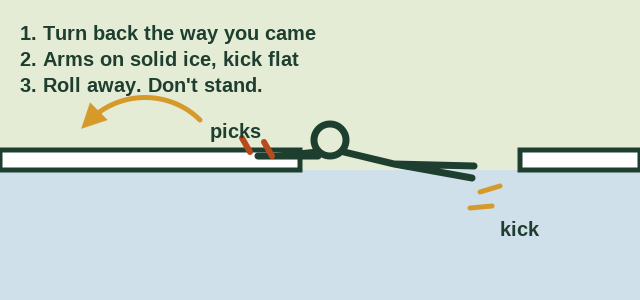
- Get your breathing under control. Stay calm, as the NWS and NPS both put it. The gasping passes.
- Turn back the way you came. That ice held you. The NWS Boston office, citing Massachusetts emergency management, says to turn toward the direction you came from (NWS Boston).
- Arms on the ice, body flat, kick. Put your hands and arms on the unbroken surface and work forward by kicking. Ditch heavy gear that weighs you down (NPS Yosemite). Ice picks give you something to dig in with. IDFG lists them for self-rescue (IDFG). Wear them where you can reach them, not in the sled.
- Don't stand up. Once you're out, stay flat and roll or crawl away from the hole. Follow your tracks back to solid ice (NWS Boston).
- Get warm and dry, fast. Change into dry clothes as soon as you can (NPS). See the warm-up steps below.
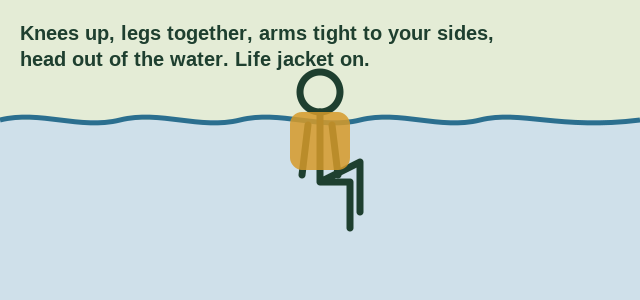
If you can't get out: the NWS (using Coast Guard guidance) says to conserve energy and heat, keep as much of your body out of the water as you can, and if you're wearing a life jacket, use the H.E.L.P. position: knees to chin, legs together, arms against your sides (NWS). IDFG suggests a life jacket under your winter coat, or a flotation suit, for early ice (IDFG).
If your buddy goes through
- Don't run out there. The NPS says not to approach the hole. Help from a distance with a rope, a branch, a rod, anything long (NPS).
- Throw or reach, then call. If that doesn't work, call 911 before you become the second person in the water (NWS Boston).
- Once they're out, have them crawl with their weight spread out, and get the wet clothes off as soon as you have dry gear (NPS).
Warming up after
The NWS shares the Red Cross steps for someone who's been in cold water (NWS): call 911, move them somewhere warm, watch their breathing and give CPR if needed, get wet clothes off, and warm them slowly with blankets or dry clothes. Wrapped hot packs are OK. Warm the trunk first, not the hands and feet. Don't put them in warm water, because rapid warming can cause dangerous heart rhythms. More on hypothermia.
Gear for this: ice fishing setup (ice picks, a float suit). Where the ice is: ice fishing map.
Sources for this page
Every link below was opened and checked on November 28, 2026. Official sources (agencies, statutes, land and water managers) carry the rules, dates and numbers on this page. Community and media sources are labelled where they appear and are never used for a rule, limit or date.