Not a substitute for training. This is a plain summary of what the linked medical and agency sources say, so you know what to expect. It is not medical advice. In an emergency, call 911. Then take a real class: see kit and training.
Shed and chukar country is steep, loose and rocky. Ankles roll. And a heel blister on day one can finish a hunt by day three.
Sprains
A sprain is a stretched or torn ligament. Ankles, knees and wrists are the usual ones (Mayo Clinic). Mayo Clinic's first aid is R.I.C.E.:
- Rest it.
- Ice it for 15 to 20 minutes at a time, with a cloth between the ice and your skin. Snow in a bag works the same way. Never more than 20 minutes at a time.
- Compress it with an elastic wrap.
- Elevate it above the heart when you can.
Get medical care right away if you can't put weight on it, the joint feels unstable or numb, or there's pain right over the bone (Mayo Clinic). Those can mean a full tear or a break.
Broken bones
A fracture needs medical care. Call 911 for major trauma, heavy bleeding, a limb that looks deformed, bone through the skin, numb or discolored fingers or toes past the injury, or a suspected neck, head or back injury (Mayo Clinic).
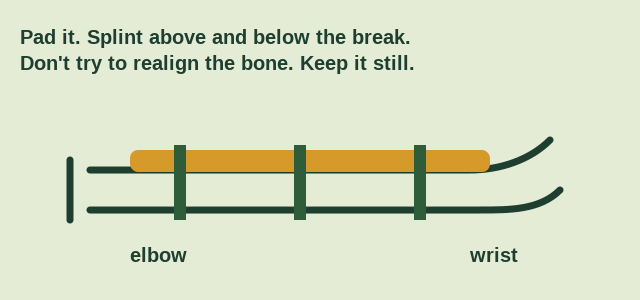
While you wait, per Mayo Clinic:
- Don't move them unless you have to.
- Stop any bleeding with pressure and a clean cloth.
- Keep it from moving. Don't try to realign the bone or push a bone back in. If you're trained and help is a long way off, splint the area above and below the break. Padding helps with pain.
- Cold packs, wrapped, for swelling and pain.
- Watch for shock. If they feel faint or breathe in short, rapid breaths, lay them down with the head slightly lower than the trunk, and raise the legs if you can.
A moldable splint is light and lives in the bottom of the pack. Trekking poles and a closed-cell pad are what most people end up improvising with. Pick on kit and training.
Blisters
Mayo Clinic's advice (Mayo Clinic):
- Treat the hot spot. A hot spot means a blister is forming. Put tape, a blister bandage or moleskin on it right away. Mayo Clinic says athletic tape and duct tape both work for taping ahead of time.
- Leave it closed if you can. Unbroken skin keeps bacteria out. Cover it with a bandage or a moleskin donut, a piece with a hole cut out for the blister.
- If you have to drain it: wash it, use a clean needle and prick near the edge in a few spots. Leave the skin on top. Ointment and a nonstick pad over it.
- Prevent it: boots that fit, moisture-wicking socks instead of cotton, and dry socks when yours get wet.
- See a doctor if it looks infected: spreading color, more pain, pus or warmth.
Feet first: boots, socks and traction for steep country.
Sources for this page
Every link below was opened and checked on November 28, 2026. Official sources (agencies, statutes, land and water managers) carry the rules, dates and numbers on this page. Community and media sources are labelled where they appear and are never used for a rule, limit or date.
Medical and first aid training organizations (first aid steps)
- Mayo Clinic (Mayo Clinic)
- Mayo Clinic (Mayo Clinic)
- Mayo Clinic (Mayo Clinic)