Not a substitute for training. This is a plain summary of what the linked medical and agency sources say, so you know what to expect. It is not medical advice. In an emergency, call 911. Then take a real class: see kit and training.
The rocky, brushy ground that holds chukar and good bass water also holds rattlesnakes. Ticks show up on you and the dog in the warm months.
Rattlesnakes in southwest Idaho
Idaho Fish and Game says rattlesnakes are the only dangerous snakes in Idaho. The western rattlesnake is the common one across southern Idaho and up the western border. They like rocky areas, sagebrush, grasslands and spots near water. IDFG also says they're usually calm, often stay still and quiet even when approached, and that bites are rare in Idaho (IDFG Wildlife Express, May 2023).
Not getting bit
- If you hear one rattle, you're too close. Move away from the sound (IDFG).
- Watch where you step and sit, and don't reach under rocks or ledges with your hand. Most bites happen when someone surprises a snake, harasses it or tries to pick it up (IDFG).
- Rattlesnakes don't always rattle before biting, and they're most active at dawn, dusk and in warm weather. Wear boots and long pants (CDC/NIOSH).
If someone gets bit
Call 911 right away. Don't wait for symptoms (Mayo Clinic). Then, combining IDFG and Mayo Clinic:
- Move away from the snake. Don't try to kill it or catch it to bring along. A photo from a safe distance, or remembering what it looked like, is enough.
- Keep them calm and still. IDFG suggests a splint to keep the bitten limb from moving, because movement spreads venom faster.
- Take off rings, watches and anything tight before it swells.
- Clean it and cover it loosely with a clean, dry bandage (Mayo Clinic).
- Limb position: Mayo Clinic says about heart level, and IDFG's 2023 guide says below the heart. Both agree: don't raise it.
- Mark the swelling edge and the time if it spreads. Mayo Clinic says that helps the hospital.
Don't: use a tourniquet, cut the bite, try to suck out venom, or ice it. No caffeine or alcohol. Mayo Clinic also says to avoid aspirin, ibuprofen and naproxen because they can increase bleeding. Acetaminophen is OK for pain.
IDFG and the CDC both put "leave it alone" first. That goes for the dog too, so keep it close in snake country.
Ticks
Idaho's Department of Health and Welfare says the tick-borne diseases of most concern here are Rocky Mountain spotted fever, tick-borne relapsing fever and tularemia. It also says the tick that carries Lyme disease isn't known to live in Idaho (Idaho DHW).
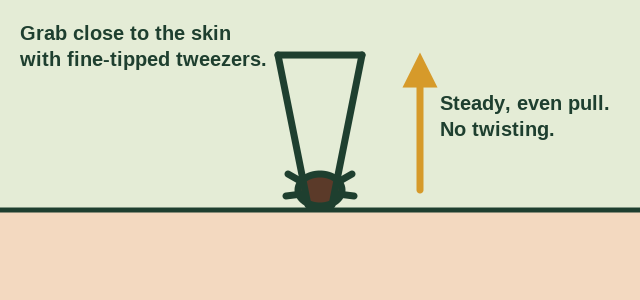
Removing one
The CDC says to remove it as soon as possible yourself, rather than waiting to see a provider (CDC):
- Grab it as close to the skin as you can with clean, fine-tipped tweezers.
- Pull straight out with steady, even pressure. Don't twist or jerk. If mouthparts stay in and won't come out easily, leave them. The skin pushes them out as it heals.
- Clean the bite and your hands with soap and water, rubbing alcohol or hand sanitizer.
- Don't crush it with your fingers. Seal it in a bag or wrap it in tape. Mayo Clinic suggests taking a picture of it (Mayo Clinic).
- Check the rest of you, and the dog. Where there's one, there may be more.
Skip petroleum jelly, nail polish and a hot match (CDC).
See a doctor if you get a rash or fever in the days to weeks after (CDC). Idaho DHW notes Rocky Mountain spotted fever can bring fever, chills, headache, confusion and a rash, and that early treatment reduces complications. Call 911 for a severe headache, trouble breathing, paralysis or heart palpitations (Mayo Clinic).
Sources for this page
Every link below was opened and checked on November 28, 2026. Official sources (agencies, statutes, land and water managers) carry the rules, dates and numbers on this page. Community and media sources are labelled where they appear and are never used for a rule, limit or date.
Centers for Disease Control and Prevention (CDC) 2
Idaho Department of Health and Welfare 1
Idaho Fish and Game (IDFG) 1
Medical and first aid training organizations (first aid steps)
- Mayo Clinic (Mayo Clinic)
- Mayo Clinic (Mayo Clinic)